Anti-Climb Mesh Fencing: 358 vs V Mesh vs Twin Mesh
What makes a fence anti-climb
A mesh fence is anti-climb when an intruder can't get a foot or fingers into it. Three things decide that: aperture, wire and height.
- Aperture. The gap between wires is the biggest factor. An opening of 50mm or more takes a boot toe or a full hand. An opening of 12.5mm doesn't.
- Wire gauge and welds. Thicker wire, welded at every crossing, resists cutting and bending. A panel that flexes gives an intruder leverage.
- Height. Taller fences are slower to climb and easier to spot someone on. Most security specs start at 2.4m, and high-risk sites go to 3.0m.
The fixings matter too. A panel that can be unbolted from outside isn't secure, however small its aperture. All three Armex systems below use anti-tamper fixings.
Short answer: 358 mesh is the true anti-climb fence. Twin mesh is a strong, rigid deterrent. V mesh is a cost-effective boundary, not an anti-climb barrier.
358 mesh: the anti-climb benchmark
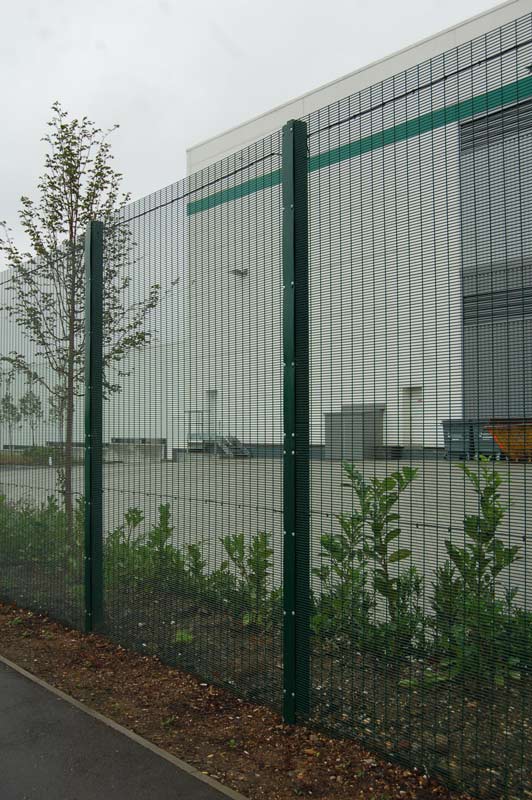
358 mesh is the standard anti-climb fence in the UK. It's named after its aperture: 3" x ½" (76.2mm x 12.5mm), on an 8-gauge (4mm) wire.
- No foothold or fingerhold. A 12.5mm gap is too narrow for a boot toe or fingers, so there's nothing to pull up on.
- Hard to cut. The dense 4mm wire grid means many more cuts to open a hole than a 200 x 50mm panel. Standard bolt croppers struggle to get a bite.
- Rigid. It's welded at every intersection, so it doesn't flex under body weight.
- Heights. Armex358 is stocked at 1.8m, 2.0m, 2.4m and 3.0m, in green (RAL 6005) or black (RAL 9005).
- Add-ons. It takes barbed or razor wire arms, electric outriggers and CCTV brackets.
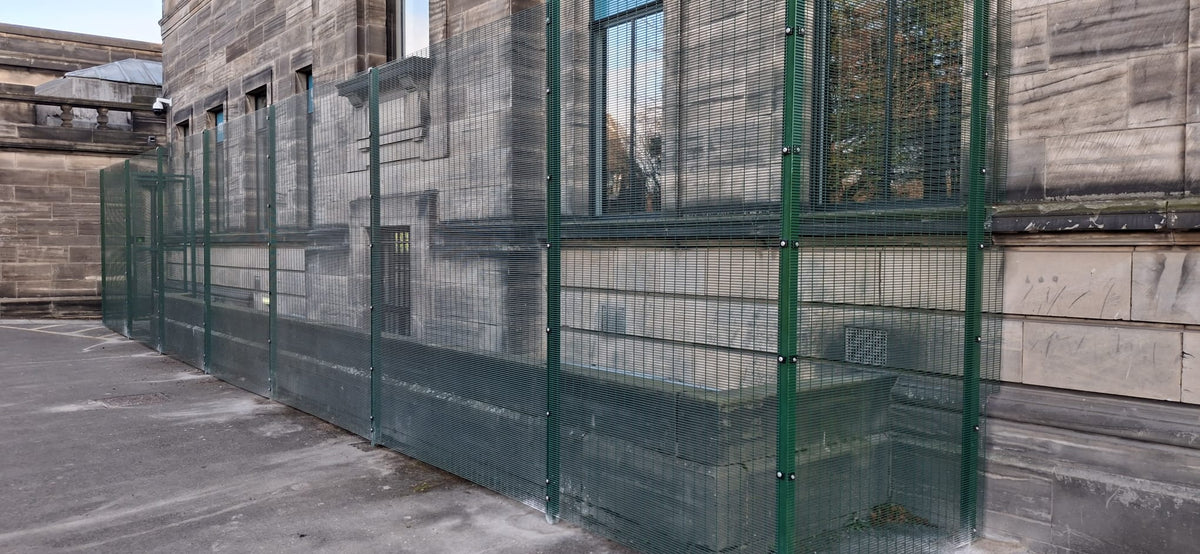
358 is also called prison mesh, anti-climb mesh or weldmesh 358. It's specified for prisons, schools, data centres, utilities, transport sites and high-risk commercial yards. The trade-off is cost and weight: it's the heaviest and most expensive of the three. See it in use: 3.0m Armex358 at an art gallery service zone.
Twin mesh (868 and 656): rigid deterrent, not true anti-climb
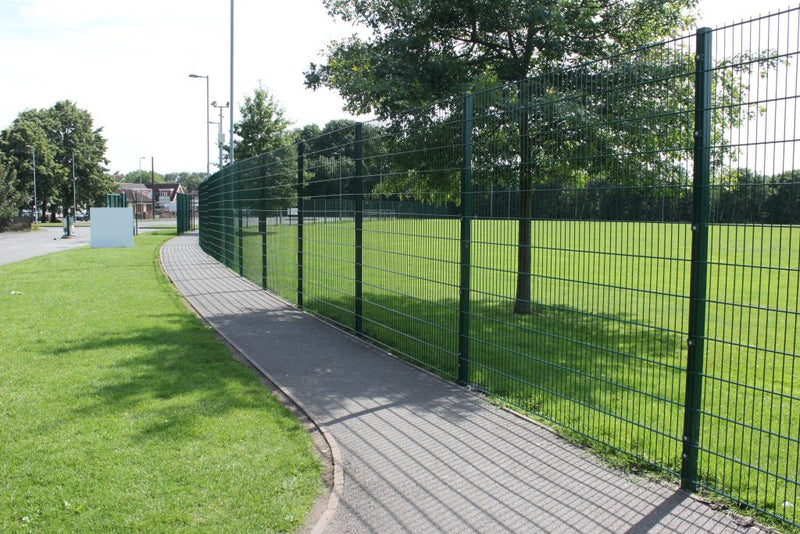
Twin wire mesh uses pairs of horizontal wires clamped around vertical bars. That makes a very stiff panel with a clean, ordered look. The 200 x 50mm aperture, though, is wide enough to get a foot into.
- 868 (8-6-8mm). This is the heavy gauge. Its 8mm twin horizontals are much harder to cut or bend than standard mesh. It suits higher-security commercial sites, especially at 2.4m to 3.0m.
- 656 (6-5-6mm). This is the lighter, lower-cost gauge, for standard commercial boundaries.
- Heights. Both gauges come in 1.8m, 2.0m, 2.4m and 3.0m, in green or black.
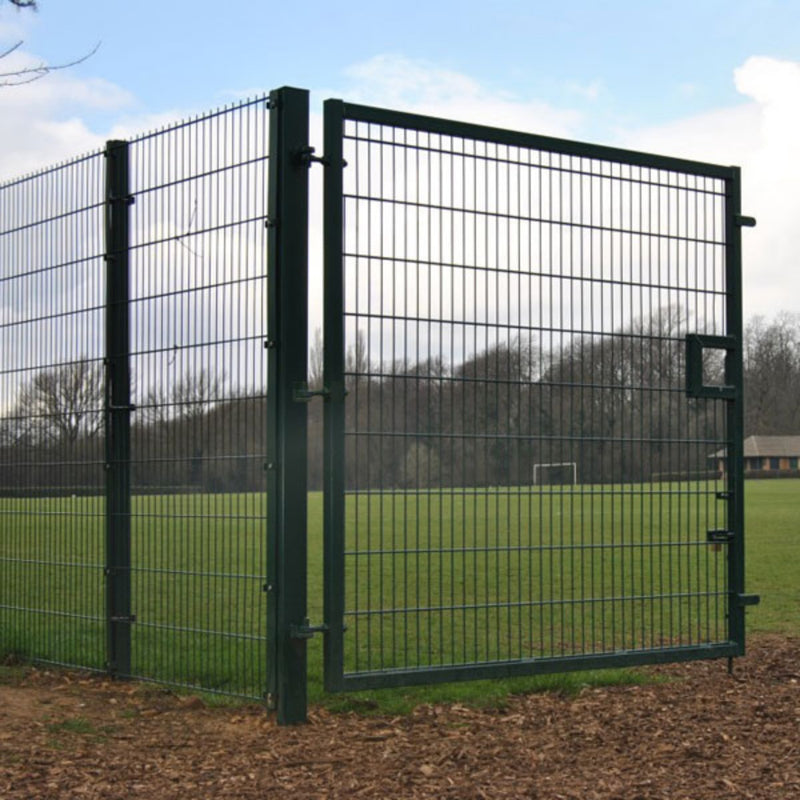
Twin mesh is a strong choice where you need to deter and delay, and appearance matters: business parks, car parks, schools and utilities. If the brief says anti-climb, either specify 358 or fit an anti-climb topping to a tall 868 fence. Armex868 security gates match it for access points.
V mesh: secure boundary, not an anti-climb barrier
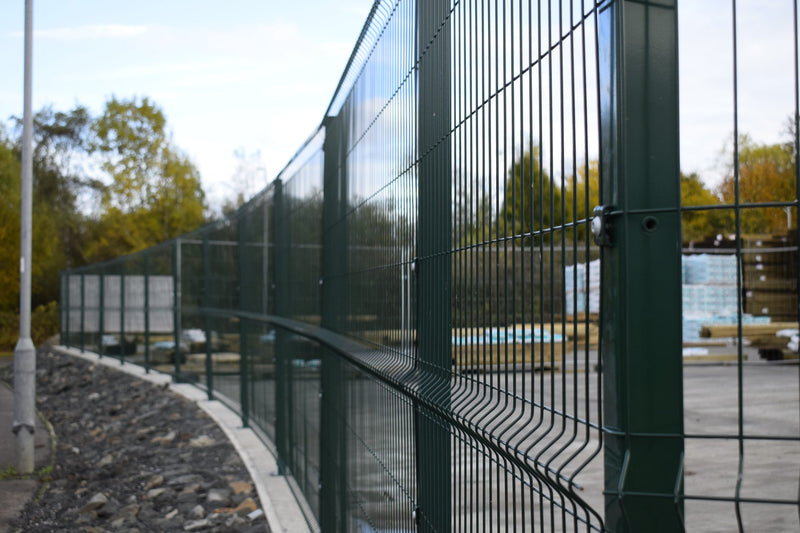
V mesh (Armex45) is the most widely used commercial perimeter fence in the UK. It's cost-effective and quick to install, but it isn't anti-climb.
- Why it's climbable. The 200 x 50mm aperture takes a boot toe, and the V-folds give an extra foothold.
- Where it's strong. 3m wide panels mean fewer posts. The V-profile steps well on sloping ground. Panels are held with a security clip and M8 anti-tamper bolt.
- Spec. 4mm vertical and 5mm horizontal wire, at 1.8m, 2.0m and 2.4m, in green or black.
V mesh is the right call for warehouses, yards, sports grounds and construction perimeters, where the aim is a clear, durable boundary at a sensible price. For the full head-to-head, read V mesh vs 358 mesh.
358 vs twin mesh vs V mesh at a glance
If the brief says anti-climb, specify 358. If it says secure and smart, use 868. If it says boundary on a budget, use V mesh.
| Armex358 | Armex868 / 656 twin mesh | Armex45 V mesh | |
|---|---|---|---|
| Aperture | 76.2 x 12.5mm | 200 x 50mm | 200 x 50mm |
| Wire | 4mm, welded every crossing | 8-6-8mm or 6-5-6mm | 4mm vertical, 5mm horizontal |
| Anti-climb | Yes: no foot or fingerhold | Partial: rigid, but takes a foot | No: aperture and V-folds give footholds |
| Cut resistance | Highest | High (868) / medium (656) | Medium |
| Heights | 1.8m to 3.0m | 1.8m to 3.0m | 1.8m to 2.4m |
| Relative cost | Highest | Middle | Lowest |
| Best for | Prisons, schools, data centres, utilities, high-risk yards | Business parks, car parks, schools, utilities | Warehouses, yards, sports grounds, construction sites |
Matching it to the site:
- Schools and colleges. Use 358 at 2.4m where pupils or intruders might climb, and 868 for frontages where looks matter.
- Data centres, utilities, transport. Use 358 at 2.4m to 3.0m, usually with a topping and CCTV brackets.
- Industrial and logistics yards. Use V mesh or 656 for the main run, and 358 around high-value storage or plant.
- Sloping sites. V mesh steps best. If you need anti-climb on a slope, 358 can be stepped too. Just tell us how far the ground drops along the run when you ask for a quote.
Anti-climb spec checklist
An anti-climb fence is only as good as its weakest point. Check these before you price:
- Height. 2.4m minimum for security, and 3.0m for high-risk perimeters.
- Posts and footings. Posts and footings must suit the panel weight and wind loading. 358 and 868 are heavier than V mesh.
- Fixings. Fit anti-tamper fixings on the secure side, with no bolts removable from outside.
- Ground gap. Keep the gap at the bottom tight, so nobody can crawl under or lever the panel.
- Toppings. Specify barbed or razor wire arms or outriggers where the risk justifies it, and check planning first.
- Gates. Match the gate security level to the fence. A 358 line with a light gate is a weak point.
- Finish. Galvanised to BS EN ISO 1461 and powder coated, so it lasts outdoors with minimal maintenance.
FAQ
Is anti-climb mesh the same as 358 mesh?
In the UK trade, yes. Anti-climb mesh, prison mesh and 358 mesh usually all mean the 76.2 x 12.5mm welded panel.
Is V mesh anti-climb?
No. Its 200 x 50mm aperture and V-folds give footholds. It's a secure boundary fence, not an anti-climb barrier.
Is twin mesh anti-climb?
Not on its own. 868 is very rigid and hard to cut, but the aperture takes a foot. Add a topping, or use 358 where anti-climb is specified.
What height should an anti-climb fence be?
Use 2.4m for most security perimeters, and 3.0m for high-risk sites such as utilities, data centres or prisons.
Can I mix systems on one site?
Yes, and it's often the best value. Run V mesh or 656 on low-risk boundaries and 358 around the high-risk areas.
Get a quote
Fencepoint supplies Armex358, Armex868/656 and Armex45 V mesh to contractors across the UK, with posts, fixings and matching gates. Send us your metres, height and colour, and we'll come back quickly with a price. Request a quote.